Malta Theory Test Questions: What to Expect & How to Practise (2026)
See what Malta theory test questions are really like — the 35-question format, the 14 topic categories, and the all-or-nothing multi-answer MARK questions — with sample questions and free practice.
The Malta car (category B) theory test is a computer-based exam of 35 multiple-choice questions that you must complete in 45 minutes, and you pass by answering at least 30 correctly, roughly 85%. Questions are drawn from 14 official topic areas covering road signs, priority rules, speed limits and safe driving, administered by Transport Malta at the Theory Test Centre on Gwardamangia Hill. The best way to practise is to sit timed mock tests that mirror the real format, including the tricky multi-answer questions, until you consistently score above the pass mark. You can start right now with a free Malta practice test that copies the exam structure question for question.
If you want the full picture of booking, fees, eligibility and what happens on exam day, read our complete Malta driving theory test guide. This article focuses on one thing: the questions themselves, what they look like, and how to practise them so nothing surprises you.
What are the Malta theory test questions like?
The Malta theory test asks 35 questions in 45 minutes, and every question is multiple choice with answer options shown on screen. You tap your choice, move forward or back, and review flagged questions before submitting. According to Transport Malta, the exam is offered in both English and Maltese, so you choose your language at the start. The tone is practical rather than academic: most questions describe a real driving situation and ask what you should do.
Because Malta drives on the left and its signage follows the European (Vienna Convention) style, the questions blend two things. You need to recognise standardised European signs, and you need to apply left-hand-drive priority logic at junctions and roundabouts. That combination trips up drivers who trained abroad on right-hand traffic.
In our experience helping learners prepare, the single biggest shock is not the difficulty of any one question. It is the narrow margin for error. With a pass mark of 30 out of 35, you are allowed only five mistakes across the entire paper. That changes how you should revise, because guessing on topics you never studied is expensive.
What topics do the questions cover?
Questions are pulled from 14 official topic categories defined by Transport Malta, so a strong candidate cannot simply memorise signs and skip the rules. The 14 categories span the full syllabus, and a typical 35-question paper samples across most of them rather than clustering in one area. Expect a broad mix on the day.
Here is a representative view of the areas the categories cover:
- Road signs and road markings (warning, prohibition, mandatory and information signs)
- Right of way and priority at junctions, roundabouts and narrow roads
- Speed limits for different roads and vehicle types
- Traffic lights and signals, including police and hand signals
- Pedestrians and vulnerable road users, such as cyclists and motorcyclists
- Motorway and main-road rules, lane discipline and overtaking
- Documents and licensing, insurance and vehicle registration
- Vehicle safety and maintenance, tyres, lights and loads
- Alcohol, drugs and fitness to drive
- The environment and fuel-efficient driving
- First aid and accident procedure
- Stopping, parking and general road discipline
One category deserves its own study session: road signs. They appear across many questions, not just the sign-identification ones, so knowing them well lifts your whole score. Our dedicated Malta road signs guide breaks them down by shape and colour so you can recognise a sign in under a second.
How do the multi-answer MARK questions work?
Some Malta theory questions are multi-answer "MARK" questions, where more than one option is correct and you must select every right answer. Transport Malta scores these all-or-nothing: a partial answer earns zero marks, even if you got two of three correct. This scoring rule is why so many well-prepared learners lose points they did not expect to lose.
Why do these questions catch people out? Standard multiple-choice conditions you to hunt for the single best answer and stop reading. A MARK question punishes that habit. You have to weigh each option independently and decide, for every one, whether it is true or false in Maltese law. Miss one correct box, or tick one wrong box, and the whole question collapses to nothing.
Think about what that does to your margin. If two MARK questions go to zero because you selected only the "most obvious" answer, you have burned two of your five allowed mistakes on a technicality. That is the difference between a comfortable pass and a resit. We cover the tactics for these in detail in our guide to multi-answer MARK questions, but the core habit is simple: read every option to the end before you commit.
What question formats should you expect?
Roughly speaking, Malta theory questions fall into three recognisable formats, and knowing them in advance removes most of the anxiety. Each format tests a different skill, so your practice should cover all three rather than favouring the sign pictures because they feel easier. A balanced revision plan mirrors the exam's own balance.
Sign identification
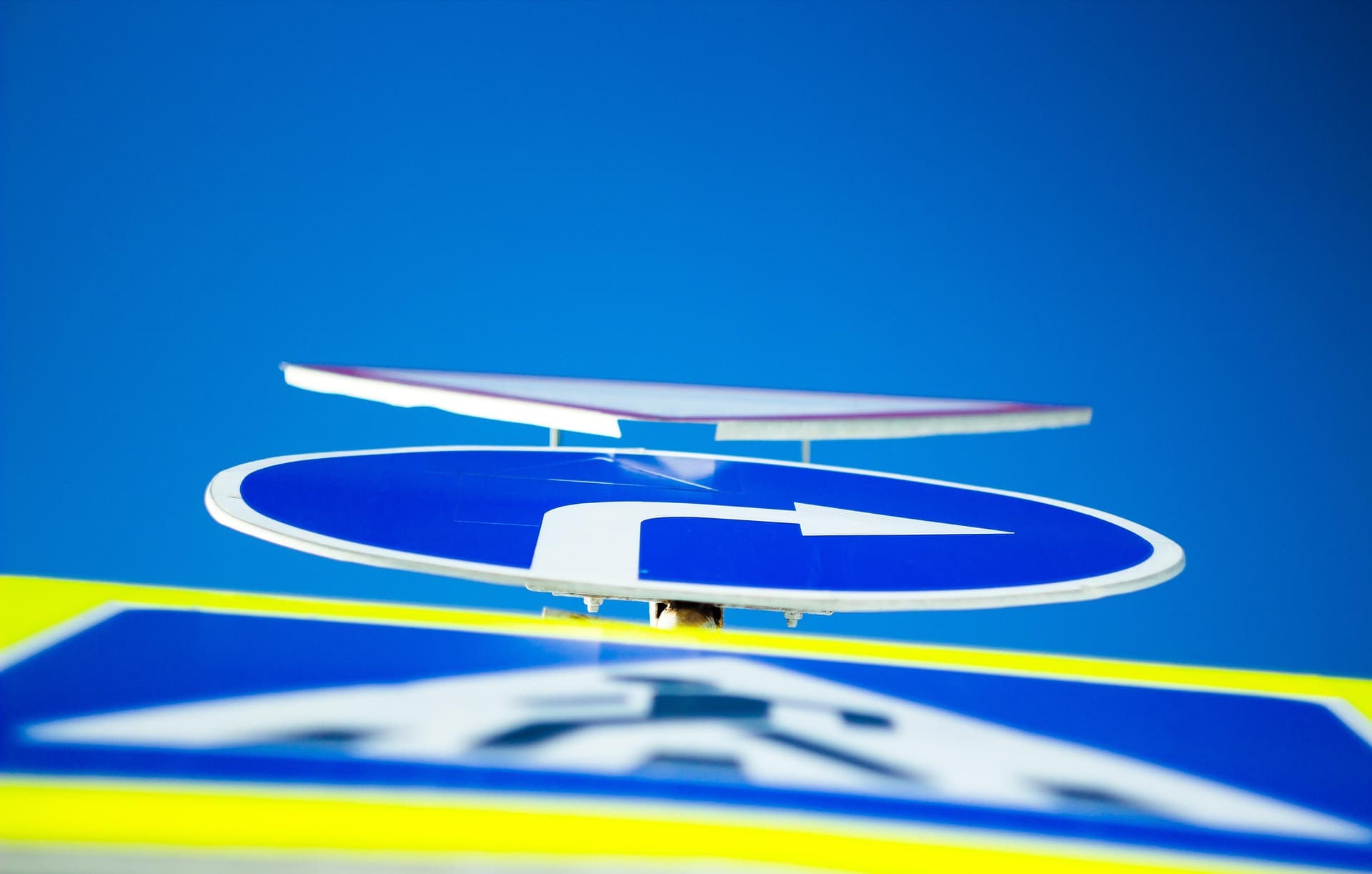
These questions show a road sign and ask what it means, or describe a meaning and ask you to pick the matching sign. They reward fast visual recall. Because Malta uses European-style signs, colour and shape carry consistent meaning: red circles prohibit, blue circles instruct, red triangles warn.
Scenario and right-of-way
These describe a junction, roundabout or road layout and ask who goes first or what you should do. They are the questions where left-hand-driving logic matters most. You cannot memorise them one by one, so you need to understand the underlying priority rules and apply them.
Rule recall
These ask for a specific fact: a speed limit, a legal blood-alcohol point, a document requirement, or a stopping distance. They are pure knowledge checks with little room for reasoning, which makes them the easiest marks to secure through repetition and flashcard-style practice.
Sample Malta theory test questions to practise
The questions below are illustrative practice examples written to match Maltese and European rules. They are not copied from the official exam, but they show the style, difficulty and reasoning the real test expects. Work through them without looking at the answers first, then check your reasoning.
Question 1 (sign identification). You see a red circular sign with a white horizontal bar in the centre. What does it mean?
- A. No entry for vehicles
- B. One-way street ahead
- C. End of all restrictions
Answer: A. A red circle with a white horizontal bar means no entry for vehicular traffic.
Question 2 (right of way). You are approaching a roundabout in Malta. Which vehicles normally have priority?
- A. Traffic already on the roundabout, coming from your right
- B. Traffic waiting to enter from your left
- C. Whichever vehicle is larger
Answer: A. On Maltese roundabouts you give way to traffic already circulating, which approaches from your right.
Question 3 (rule recall). What is the general speed limit on Malta's roads unless a sign shows otherwise in built-up areas?
- A. 30 km/h
- B. 50 km/h
- C. 80 km/h
Answer: B. In built-up areas the default limit is 50 km/h unless signs indicate a different limit.
Question 4 (MARK, multi-answer). Which of the following are correct actions before changing lanes? Select all that apply.
- A. Check your mirrors
- B. Signal in good time
- C. Check your blind spot
- D. Accelerate hard so you clear the gap quickly
Answer: A, B and C. All three are required. D is unsafe, and because this is a MARK question, missing any correct option scores zero.
Question 5 (fitness to drive). How does alcohol affect your ability to drive?
- A. It improves your reaction time
- B. It slows your reactions and impairs judgement
- C. It has no effect below the legal limit
Answer: B. Alcohol slows reactions and impairs judgement, which is why driving under its influence is dangerous and illegal.
Notice how Question 4 behaves differently from the rest. If you ticked only A and B because they felt "most important," you would score nothing. That is the MARK trap in miniature. Ready to try a full set under real conditions? Sit a free Malta practice test and see where your weak categories are.
How do you practise Malta theory test questions effectively?
The most effective preparation is timed mock tests that replicate the 35-question, 45-minute format, taken repeatedly until you clear the 30-mark pass threshold with room to spare. Reading a handbook builds knowledge, but only mock tests build exam stamina and expose the categories you quietly avoid. Aim to score 33 or higher consistently before you book, so a couple of unlucky questions cannot fail you.
We have found a simple routine works best for most learners. Take a full timed mock, then review every wrong answer and identify its topic category. If three misses cluster in "right of way," you have found your study target for tomorrow. Repeat daily, rotating through categories, and your weak spots shrink fast.
Do not skip the MARK questions during practice, even though they feel harder. Practising them under real scoring rules trains you to read every option, which is the exact habit the exam rewards. A free Malta practice test that mirrors the official structure gives you unlimited attempts, so there is no reason to walk in cold.
Frequently asked questions
How many questions are on the Malta theory test?
The Malta car (category B) theory test has 35 multiple-choice questions and you have 45 minutes to complete them, according to Transport Malta. Questions are drawn from 14 official topic categories and delivered on a computer at the Theory Test Centre on Gwardamangia Hill. You can take it in English or Maltese.
What is the pass mark for the Malta theory test?
You must answer at least 30 out of 35 questions correctly, which is about 85%, so only five mistakes are allowed. Multi-answer MARK questions score zero for partial answers, which makes that five-mistake margin tighter than it looks. Consistent mock-test scores of 33 or more give you a safe buffer.
Are the Malta theory test questions the same every time?
No. The exam draws a fresh selection from a large official question bank across the 14 categories, so no two papers are identical and you cannot pass by memorising a fixed list. That is why understanding the rules beats rote learning. Broad practice across every category is the reliable route to a pass.
Where can I practise Malta theory test questions for free?
You can practise free with a free Malta practice test that mirrors the real 35-question, 45-minute format, including multi-answer MARK questions. It gives instant feedback and flags your weak categories after each attempt. Pair it with our Malta driving theory test guide for booking and eligibility details.
Final thoughts
Malta's theory test is fair but unforgiving: 35 questions, 45 minutes, and only five mistakes allowed to reach the 30-mark pass. The questions are not designed to trick you, but the multi-answer MARK format and the tight margin punish shallow revision. If you understand the 14 topic categories, recognise European-style signs on sight, and apply left-hand priority rules confidently, you have covered what the exam actually measures.
The fastest path from here is repetition under real conditions. Take timed mocks, review every miss by category, and drill the MARK questions until reading every option becomes automatic. Start with a free Malta practice test, keep sitting it until you clear 33 out of 35, and book your exam with confidence. Good preparation turns a nerve-racking test into a formality.
Related Guides
Continue learning with these related articles

How to Book the Malta Driving Theory Test 2026: Centre, Fees, What to Bring
Book the Malta driving theory test at the Pieta Theory Test Centre: phone numbers, online booking, the €30.25 fee, what to bring, and the 35-question format.
Malta Road Signs Explained: A Complete Guide for the Theory Test (2026)
Learn every Malta road sign category — warning, prohibitory, mandatory, information, priority, and road markings — using a shape-and-colour system that lets you decode any sign on the theory test.

Transport Malta Theory Test 2026: Format, Booking, Centres and How to Pass
Pass the Malta theory test with confidence. Covers the 35-question format, 85% pass mark, multi-answer MARK questions, 14 topic categories, costs (EUR 108-125), study strategy, and step-by-step licensing process.
Malta Driving Test: What to Expect on Test Day
What to expect on Malta driving test day. The practical test structure, show-and-tell questions, assessed skills, common fail reasons (54% failure rate in 2024), and tips to pass on your first attempt.
Ready to test your knowledge?
Put what you've learned into practice with our free driving theory practice tests.
Start Practicing