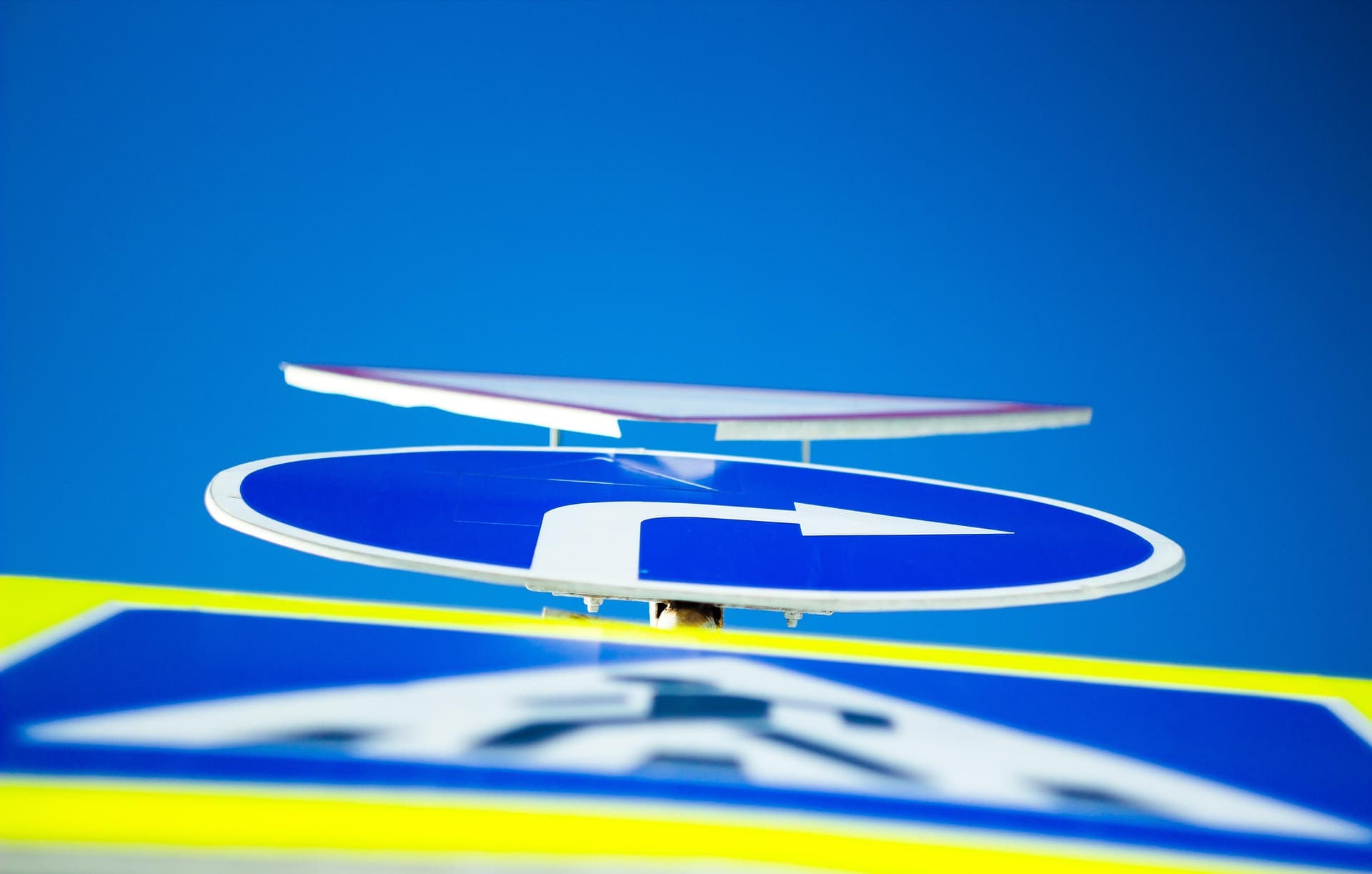
Malta Road Signs Explained: A Complete Guide for the Theory Test (2026)
Learn every Malta road sign category — warning, prohibitory, mandatory, information, priority, and road markings — using a shape-and-colour system that lets you decode any sign on the theory test.
Malta road signs fall into six main categories: warning signs, prohibitory (regulatory) signs, mandatory signs, information and direction signs, priority signs, and road markings. Because Malta follows the European (Vienna Convention) style, each category has a consistent shape and colour, so once you learn the visual logic you can decode almost any sign, even one you have never seen before. That skill matters because the theory test shows you a sign and asks you to identify its meaning.
Malta drives on the left, but its signs look much like those across the UK and the EU: triangular warnings with a red border, circular prohibitions, blue mandatory discs, and rectangular information panels. Understanding why a sign is round or triangular, red or blue, is far more reliable than memorising each one in isolation. This guide breaks down every category, gives clear examples, and shows how signs appear in the official theory test so you can walk in prepared.
Key takeaways
- Malta uses six main sign categories built on the European (Vienna Convention) system, so shape and colour reveal meaning at a glance.
- Triangular red-bordered signs warn, circular red signs prohibit or regulate, blue circles give orders, and rectangles inform.
- Recognising a sign from its symbol, not its wording, is the core skill the Malta theory test measures.
- Practising real signs and mock questions before test day builds the fast recognition examiners look for.
What are the main road sign categories in Malta?
Malta's road signs split into six practical groups, each with its own visual code. Warning signs alert you to hazards ahead. Prohibitory signs ban an action. Mandatory signs command one. Information and direction signs guide you. Priority signs settle who goes first. Road markings reinforce all of these on the tarmac itself. Learn the code, and unfamiliar signs stop being a guessing game.
The beauty of the European system is its consistency. A shape or colour almost always means the same thing, whatever symbol sits inside it. That is why a driver from Malta can read a sign in Italy, France, or Germany without a phrasebook. For your theory test, it means you can reason your way to the correct answer instead of relying on memory alone. Curious how the whole exam fits together? The Malta driving theory test guide covers the full picture.
| Category | Shape | Colour | Meaning | Example |
|---|---|---|---|---|
| Warning | Triangle (point up) | White with red border | Hazard ahead, prepare to react | Sharp bend, pedestrian crossing |
| Prohibitory / Regulatory | Circle | White or blue with red border | Something is banned or restricted | No entry, speed limit, no overtaking |
| Mandatory | Circle | Blue with white symbol | You must do this | Turn left ahead, minimum speed |
| Information / Direction | Rectangle | Blue or green | Guidance and route details | Parking, one-way, motorway direction |
| Priority | Varies (triangle, octagon, diamond) | Mixed | Who has right of way | Stop, give way, priority road |
| Road markings | Lines and symbols on the road | White or yellow | Reinforce lanes, stopping, waiting | Centre lines, stop line, box junction |
How do warning signs work in Malta?
Warning signs in Malta are triangular with a red border and point upward, telling you a hazard lies ahead. The symbol inside shows what to expect: a bend, a junction, roadworks, animals, or a slippery surface. They do not force an action; they ask you to slow down, stay alert, and be ready to respond. Their bold red edge is designed to catch your eye from a distance.
In Malta's road-sign system, triangular signs with a red border always warn of a hazard rather than issue an order. The upward-pointing shape and red edge follow the European (Vienna Convention) convention, giving drivers a consistent visual cue that applies across the EU and the UK alike.
Many learners waste time memorising individual warning symbols when the shape already does the heavy lifting. If a sign is a red-bordered triangle, your answer is never "you must" or "you cannot"; it is always "watch out for." That single rule eliminates whole groups of wrong answers on the test. When you are unsure, decode the shape first, then read the symbol.
Common warning signs to know
Expect signs for bends, crossroads, roundabouts ahead, pedestrian crossings, children near schools, road narrows, and slippery roads. Malta's dense, older road network makes junction and bend warnings especially frequent. Treat each one as a prompt to ease off the accelerator and scan the road, even before you consciously read the symbol inside.
What do prohibitory and mandatory signs mean?
Prohibitory and mandatory signs are both circular, but they mean opposite things. A circle with a red border prohibits or restricts: no entry, no overtaking, no stopping, or a speed limit. A solid blue circle commands a positive action: turn here, keep left, or follow this lane. Red says "do not," blue says "you must." That colour split is one of the most useful shortcuts on the entire theory test.
Prohibitory signs often show a symbol crossed by a red diagonal or simply enclosed in the red ring. Speed limits are the classic example: a red circle around a number sets the maximum. A red circle with nothing but white inside means no vehicles at all. Because these signs regulate behaviour, they carry legal force, and ignoring one is an offence in Malta just as it is on any European road.
In our experience helping learners prepare, the red-versus-blue circle rule is the single fastest confidence boost. Once it clicks, students stop second-guessing whether a round sign is banning or ordering, and their mock-test scores climb almost immediately. It is a small mental model with an outsized effect. Want to test it yourself? Try a free Malta practice test and watch how quickly circular signs become automatic.
Mandatory signs in daily driving
Blue mandatory circles keep traffic flowing safely. They tell you which way to go at a junction, direct you into a specific lane, or set a minimum speed on faster roads. On Malta's roundabouts and one-way systems, blue direction arrows are everywhere. Follow them precisely, because they are instructions, not suggestions.
How do information, direction, and priority signs help?
Information and direction signs are rectangular and coloured blue or green, guiding you to places, routes, and facilities without commanding or warning. Priority signs, a smaller but crucial group, decide who moves first: the octagonal STOP sign, the downward triangle for give way, and the diamond marking a priority road. Together, these signs keep Malta's busy junctions predictable and orderly, which is exactly why the test checks that you know them.
Direction signs point you toward towns, the airport, or key routes, using blue panels for ordinary roads. Information signs mark parking, one-way streets, hospitals, and dead ends. Priority signs deserve extra attention because they carry immediate safety consequences. The STOP sign is the only octagonal sign in the whole system, deliberately unique so drivers recognise it instantly, even in poor light or a foreign language.
The octagonal STOP sign is the only eight-sided sign in Malta's road-sign system, a deliberate design choice under the Vienna Convention so it stays recognisable from the back, in fog, or when partly obscured. Its unique shape lets drivers identify it without reading a single word.
Reading road markings
Road markings work alongside signs. White lines separate lanes and mark the road centre; a solid line means do not cross, while broken lines allow it when safe. Yellow lines at the kerb restrict waiting and parking. A box junction with criss-cross yellow lines means you must not enter until your exit is clear. These markings often appear in test questions paired with the matching sign.
How do road signs appear on the Malta theory test?
The Malta theory test uses official questions, and sign recognition is central to it. Typically you see an image of a sign and choose its correct meaning from several options, or you read a scenario and pick the sign that applies. The exam covers dozens of official signs across all six categories, so broad familiarity matters more than memorising a short list. Recognising the symbol quickly is the skill being measured.
Because the test presents real signs rather than descriptions, guessing from wording will not help you. You need to see the shape, register the colour, and read the symbol in a couple of seconds. That is why steady practice beats last-minute cramming. Reviewing the full catalogue in advance means no sign feels unfamiliar on the day. You can browse and practise all Malta road signs until recognition becomes second nature.
The learners who struggle are rarely the ones who do not know the signs; they are the ones who freeze because a sign looks slightly different from the flashcard they memorised. Malta's real signs vary in wear, angle, and background. Practising with varied images, not a single perfect version of each sign, builds the flexible recognition the test rewards. For exact question formats and the pass process, defer to the Malta driving theory test guide.
Frequently asked questions
How many road signs are on the Malta theory test?
The Malta theory test draws on dozens of official road signs spread across all six categories: warning, prohibitory, mandatory, information, priority, and road markings. Rather than fixate on an exact count, focus on understanding the shape-and-colour system, which lets you decode signs you have not specifically memorised and answer confidently under time pressure.
Are Malta road signs the same as the UK?
Malta and the UK both drive on the left and share the European (Vienna Convention) sign style, so the shapes and colours are very similar: triangular warnings, circular prohibitions, blue mandatory discs. Some symbols and wording differ, and Malta uses its own local variations, so always study Malta-specific signs rather than assuming full UK equivalence.
Where can I practise Malta road signs?
You can practise by studying the full sign catalogue and taking realistic mock tests before your exam. Reviewing signs in context, then answering questions under timed conditions, builds the fast recognition the theory test rewards. Start with the sign catalogue, then reinforce it using a free Malta practice test to check your progress honestly.
What do the different sign colours mean in Malta?
Colour signals purpose in Malta's system. Red borders warn or prohibit, blue circles command an action, blue rectangles give information, and green panels usually indicate main routes. White and yellow road markings reinforce lanes and waiting rules. Learning this colour logic is faster and more reliable than memorising each sign individually.
Do I need to know road markings for the test?
Yes. Road markings count as part of Malta's sign system and appear in theory-test questions, often paired with a related sign. You should recognise centre lines, stop lines, give-way markings, yellow kerb restrictions, and box junctions. Understanding how markings and upright signs work together gives you a fuller, more accurate picture of any road situation.
Decode signs, do not just memorise them
Malta's road signs may look like a lot to learn, but they follow a logical, European-wide system. Once you know that triangles warn, red circles prohibit, blue circles command, and rectangles inform, you can decode almost any sign on sight. That reasoning skill, more than rote memory, is what carries you through the theory test and keeps you safe on Malta's roads afterward.
The most effective preparation combines two things: studying the full sign catalogue and testing yourself with realistic questions. Learn the shape-and-colour code first, then reinforce it through repetition until recognition is instant. When you are ready, practise all Malta road signs and put your knowledge to the test with a free Malta practice test. Master the visual logic now, and sign questions become some of the easiest marks on the exam.
Related Guides
Continue learning with these related articles
How to Book the Malta Driving Theory Test 2026: Centre, Fees, What to Bring
Book the Malta driving theory test at the Pieta Theory Test Centre: phone numbers, online booking, the €30.25 fee, what to bring, and the 35-question format.
Malta Theory Test Questions: What to Expect & How to Practise (2026)
See what Malta theory test questions are really like — the 35-question format, the 14 topic categories, and the all-or-nothing multi-answer MARK questions — with sample questions and free practice.
Transport Malta Theory Test 2026: Format, Booking, Centres and How to Pass
Pass the Malta theory test with confidence. Covers the 35-question format, 85% pass mark, multi-answer MARK questions, 14 topic categories, costs (EUR 108-125), study strategy, and step-by-step licensing process.
Malta Driving Test: What to Expect on Test Day
What to expect on Malta driving test day. The practical test structure, show-and-tell questions, assessed skills, common fail reasons (54% failure rate in 2024), and tips to pass on your first attempt.
Ready to test your knowledge?
Put what you've learned into practice with our free driving theory practice tests.
Start Practicing