Driving in Turks and Caicos: Foreign Licences, the Visitor's Permit and Rental Rules
Visiting or moving to Turks and Caicos? The 30-day rule for US, Commonwealth and IDP licences, the $30 visitor's driving permit, driving on the left, roundabouts, the posted 20 and 40 mph limits, seat belts, the 0.08 limit, and what to do after an accident.
Driving in Turks and Caicos: Foreign Licences, the Visitor's Permit and Rental Rules
If you arrive in Turks and Caicos with a valid US or Commonwealth driving licence or an International Driving Permit (IDP), and you are 17 or older, you can drive for up to 30 days after entry with no local paperwork. Stay longer and you need a visitor's driving permit from the Department of Motor Vehicles (DMV): $30, valid three months. The bigger adjustment is the road itself: traffic keeps to the left, mostly in left-hand-drive US imports, and roundabouts replace traffic lights. ExamReady is an independent study platform and is not affiliated with the DMV or the Turks and Caicos Islands Government.
Key takeaways
- A non-resident aged 17 or over with a valid US or Commonwealth licence (Canada, the UK, the Bahamas, Jamaica and others) or an IDP may drive for 30 days after entry.
- Beyond 30 days you need a visitor's driving permit: $30, valid three months, issued against your stamped passport and home licence.
- Drive on the left, usually in a left-hand-drive US import, so the driver sits on the kerb side.
- Commonly posted limits are 20 mph in settlements and 40 mph on Leeward Highway and other highways. Give way to the right at roundabouts.
- Seat belts for everyone, a 0.08 drink-drive limit, helmets on scooters, and a $350 ticket for driving on the wrong side.
- Longer-stay visitors and new residents with a US, Commonwealth or IDP licence can exchange it for a TCI licence without sitting the tests.
Can you drive in Turks and Caicos on your home licence?
Yes, for 30 days, if your licence qualifies. Section 3(3) of the Motor Vehicles (Driving Licences) Ordinance lets a non-resident aged 17 or over who is lawfully in the islands drive any vehicle of the class on their licence for up to 30 days after the date of entry. The licence must have been issued in the United States or any part of the Commonwealth, or you must hold a valid IDP.
"Commonwealth" covers far more than the UK. Canadian, British, Bahamian, Jamaican, Barbadian, Trinidadian, Australian and Indian licences all qualify. GOV.UK confirms a UK photocard licence works for one month and notes that old paper-licence holders may need a photocard or an IDP; travel.gc.ca says the same about Canadian licences.
If your licence is from anywhere else, the legal allowance depends on carrying an IDP. Rental companies may accept other licences, but the law does not, so get an IDP before you fly.
How does the visitor's driving permit work?
The visitor's driving permit covers stays beyond 30 days. Under section 7 of the Ordinance, the Director may issue a non-resident holding a US, Commonwealth or IDP licence a permit valid for three months from the date of issue. The fee is $30, and the DMV asks for your passport with the immigration officer's stamp and your valid non-TCI licence. There is no application form, though the Director may check that you can read English well enough for traffic signs.
The regulations allow the application to be made in person or by someone you authorise. Some rental companies advertise that they arrange a temporary local licence for longer-staying guests, but the DMV does not say which firms do this, so ask your rental company before you arrive. If you go yourself, the main DMV office is at Town Centre Mall, Providenciales, with smaller offices on Grand Turk, North Caicos and South Caicos. Hours and phone numbers are in our Turks and Caicos DMV guide.
What do rental companies require?
The law sets one minimum age, 17, for any licence or permit. Everything else at the rental desk is company policy, not law. Firms set their own minimum driver ages (often higher for cars than scooters), their own deposit and insurance terms, and their own rules on which licences they accept. Those policies vary, so confirm them with the company you plan to use.
Which side of the road, and how fast?
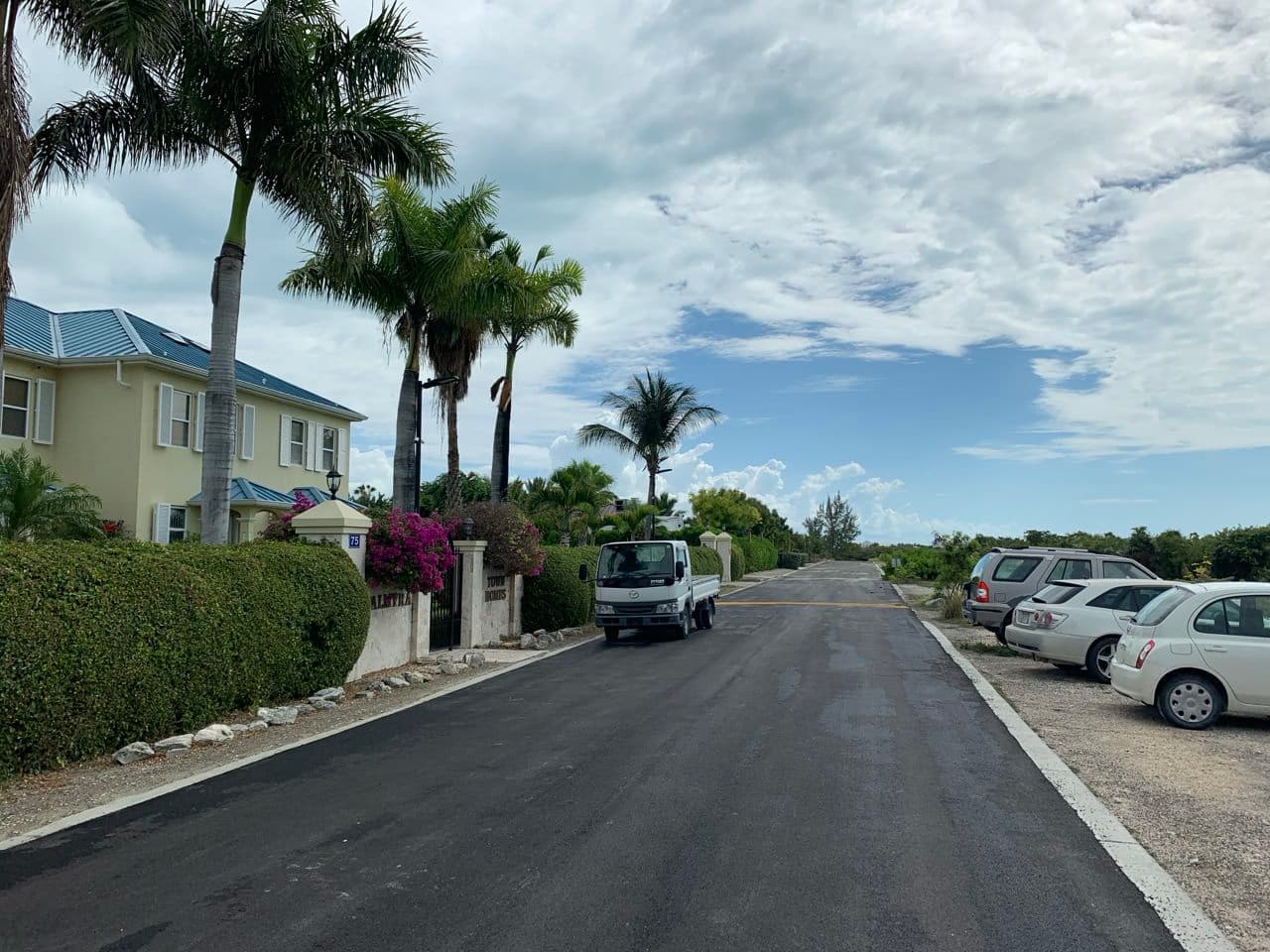
Traffic drives on the left. Section 48 of the Road Traffic Ordinance requires you to keep as far left of the road centre as possible except when overtaking, turning right or reversing, and driving on the incorrect side is a $350 ticket. Because most cars are left-hand-drive US imports, you sit on the kerb side with your passenger nearest the centre line, which makes overtaking harder to judge. Overtaking is banned at corners, junctions, bridges and the brow of a hill.
Speed limits are set road by road by order of the Director. The commonly posted limits are 20 mph in towns and settlements and 40 mph on Leeward Highway and other highways, in miles per hour, and GOV.UK and travel.gc.ca quote the same numbers. Police use laser speed guns, and the ticket is $350 for up to 10 mph over, plus $350 for every further 10 mph, capped at $1,500. Our Turks and Caicos road rules and speed limits guide covers every limit and fine.
How do roundabouts and junctions work?
Give priority to traffic approaching from the right at every roundabout unless signals or markings say otherwise (regulation 24). Give way to the right at uncontrolled crossroads too, and at a T-junction give way to traffic on the through road. Turks and Caicos has historically relied on roundabouts instead of traffic lights; signals were only defined in law in December 2023, so expect roundabouts at every major junction. Large speed bumps are common and often unmarked, so slow down through settlements.
Two parking rules catch visitors out. A yellow line along the kerb means no parking between that line and the road centre, and you must never park within 45 feet of a pedestrian crossing, where you must also give way to anyone crossing. Each is a $350 ticket. Road signs mix newer UK-style shapes with older US-style ones, so spend a few minutes with the Turks and Caicos road signs library and our guide to the 49 official signs before you drive.
What are the seat belt, helmet, drink-drive and phone rules?
Seat belts are compulsory in every seat of a car, front and rear. Each adult answers for their own belt, but for a child under 14 the driver commits the offence if the child is unbelted. There is no child-seat law: children wear an adult belt or an approved child belt. The fine is $250. Helmets are compulsory for rider and pillion on any motorcycle or scooter, also $250.
The drink-drive limit is 0.08: 35 microgrammes of alcohol per 100 ml of breath, 80 mg per 100 ml of blood or 107 mg per 100 ml of urine. Refusing a roadside breath test is itself an offence. Driving over the limit means a $1,000 fine or six months' imprisonment and at least six months' disqualification; driving while unfit through drink or drugs rises to $5,000 or 12 months with at least 12 months off the road.
There is no specific mobile phone law, whatever some rental blogs say. What applies is careless driving under section 36 ($1,000 or three months) and dangerous driving under section 35 ($5,000 or six months). A phone-distracted driver can be charged under either.
What should you do after an accident or a ticket?
After any accident, stop and give your name and address, the owner's details and the registration to anyone with reasonable grounds to ask. If you cannot do that at the scene, report the accident to a police station or a uniformed officer within 24 hours. Failing to stop is a $350 ticket. Traffic tickets are payable at the Clerk of Court within 28 days, after which they become a summons.
Staying longer? How to convert your licence
Once you become ordinarily resident, for example on a work permit or residence permit, you need a TCI driving licence. Section 4(1)(b) lets the DMV issue a full licence to anyone who produces a valid licence for the class applied for issued in the United States or any part of the Commonwealth, or a valid IDP. No sign test, written test or road test is required. A class E licence for private cars costs $150, and you need proof of identity (passport plus your work permit or residence permit). A first licence expires on your birthday after the fourth anniversary of issue; a work-permit holder's licence expires three months after legal residency ends.
Anyone with a licence from a non-Commonwealth country and no IDP takes the standard route: a $30 learner's permit, then the $20 written road signs test, the $20 written driving test and the $30 practical test in a vehicle you supply. The DMV does not publish the question count or pass mark, so prepare with the law itself and the free Turks and Caicos practice test. Our step-by-step guide to getting a driver's licence in Turks and Caicos walks through every stage.
Official sources
- Department of Motor Vehicles, Turks and Caicos Islands Government
- DMV services
- DMV fees
- DMV contact and offices
- Motor Vehicles (Driving Licences) Ordinance, Cap 13.02
- Road Traffic Ordinance and Regulations, Cap 13.01
- GOV.UK foreign travel advice: Turks and Caicos Islands
- Government of Canada travel advice: Turks and Caicos Islands
Frequently Asked Questions
Can I drive in Turks and Caicos with a US driver's licence?
Yes. A non-resident aged 17 or over with a valid US licence may drive vehicles of that class for up to 30 days after entering the islands. For a longer stay, apply to the DMV for a $30 visitor's driving permit, valid three months, with your stamped passport and your US licence.
Do Canadians need an International Driving Permit in Turks and Caicos?
No. Canada is a Commonwealth country, so a valid Canadian licence qualifies under the same 30-day rule as a US licence. Visitors staying beyond 30 days need the three-month visitor's driving permit.
Which side of the road do they drive on in Turks and Caicos?
The left. Most cars are left-hand-drive US imports, so the driver sits on the kerb side. Wrong-side driving is a $350 ticket, and at roundabouts you give way to the right.
What is the speed limit in Turks and Caicos?
Limits are posted in mph. The commonly posted limits are 20 mph in towns and settlements and 40 mph on Leeward Highway and other highways. Speeding tickets start at $350.
Do I need a car seat for my child in Turks and Caicos?
There is no child-seat law. Every child under 14 must wear a seat belt, and the driver is liable if they do not. If you want a car seat or booster, bring your own or ask your rental company whether it supplies one.
Related Guides
Continue learning with these related articles
Turks and Caicos Driving Licence Cost (2026): Every DMV Fee, Class and Renewal Rule
What a Turks and Caicos driver's licence really costs: $250 for a first class E licence if you pass first time, the $150 and $375 fee groups by class, replacement and add-class fees, validity to the birthday after four years, and the fines that add to the bill.
Turks and Caicos DMV: Offices, Hours, Fees and Services
Everything about the Turks and Caicos Department of Motor Vehicles: the four offices with addresses, phone numbers and opening hours, what to bring for each service, the full fee list, and the recent plate and tint changes.
Turks and Caicos Road Rules: Speed Limits, Roundabouts, Seat Belts and Fines
The rules of the road in Turks and Caicos with their sections and fines: drive on the left, give way to the right at roundabouts, the posted 20 and 40 mph limits, no overtaking at corners, seat belts, helmets, tint, drink driving and the ticket system.
Road Signs in Turks and Caicos: The 49 Official Signs and What They Mean
Turks and Caicos prescribes its own schedule of 49 road signs in regulation 31 of the Road Traffic Regulations: UK-style circles and triangles alongside worded plates such as SPEED LIMIT, NO WAITING and REDUCE SPEED NOW. Every group explained, in mph.
Ready to test your knowledge?
Put what you've learned into practice with our free driving theory practice tests.
Start Practicing