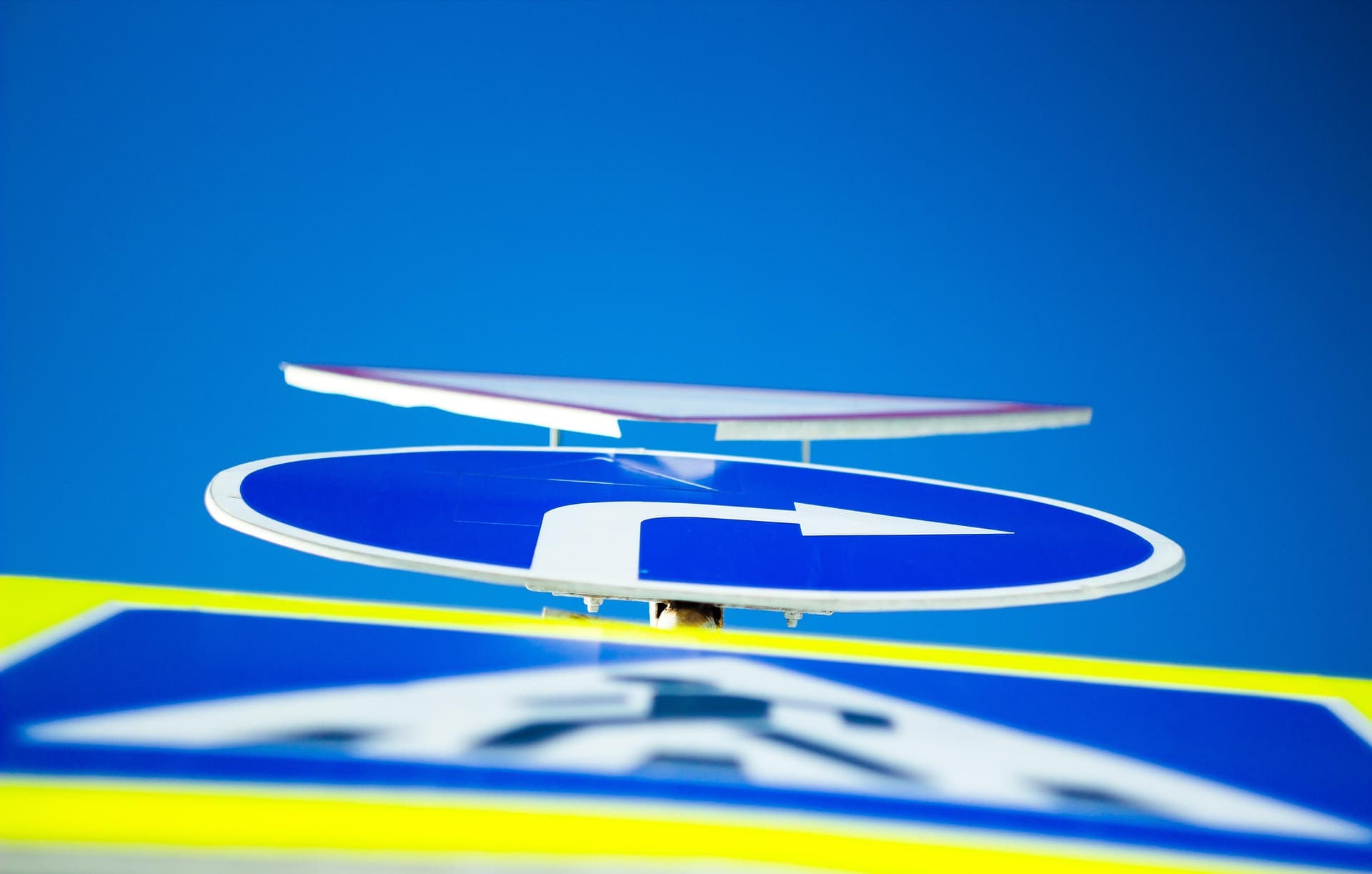
Sign Flow: Learn Road Signs Hands-Free, With Nothing to Click
Sign Flow plays your country's road signs full screen on a timer, one at a time, with a pause to recall each meaning before it is revealed. Study while you walk, eat or work.
Almost everyone preparing for a driving theory test does the same thing with road signs: they open the sign gallery, scroll for ten minutes, decide they mostly know these, and close it. The signs are the part of the syllabus people skip, not because they are hard, but because studying them is a chore of clicking through a list. So we built a study mode with nothing to click at all. Sign Flow plays your country's road signs full screen, one at a time, and moves on by itself.
You start a session and put the phone down. Each sign appears alone for a few seconds so you can try to remember what it means, then the meaning appears underneath it, then the next sign arrives. Nothing needs tapping. It runs while you walk on a treadmill, drink your coffee, eat lunch or leave it on a second monitor while you work.
Key Takeaways:
- Sign Flow is a full-screen road sign reel that advances on a timer, so a study session needs no input at all.
- Every sign shows on its own first, giving you a moment to recall the meaning before it is revealed.
- You pick the pace (10, 15, 20 or 30 seconds per sign) and the deck size (20, 30 or 50 signs).
- The deck is ordered, not random: signs you have never studied come first, then ones you have missed, then the ones you have not seen for longest.
- The screen stays awake for the whole session, and the reel pauses itself if you switch tabs.
- Sign Flow is included in the Pass Pack for your country, a one-time purchase. The free practice tests and the sign gallery stay free.
Why We Built a Study Mode With Nothing to Click
Every study tool we had already built asks something of you. A practice test asks you to answer. Sign Blitz asks you to recall a meaning and be honest about whether you knew it. Both work, and both demand that you sit down, pay attention and interact for the whole session. That is exactly why people put them off.
Road signs have a property that makes them unusual in a theory syllabus: there are a lot of them, they are almost entirely visual, and knowing them is mostly a matter of exposure. You do not need to reason about a sign. You need to have seen it enough times that its meaning arrives without effort. That kind of learning does not require your hands, and it does not really require your full attention either. It requires repetition.
So Sign Flow removes the interaction entirely. There is no answer to give and no button to press to continue. The trade is deliberate: you get a study mode passive enough to run in the background of something else, which means you will actually do it on the days you would otherwise do nothing.
How a Session Works
You choose three things before you start, then you stop touching the screen.
- How long each sign stays up. 10, 15, 20 or 30 seconds. Fifteen is the default and suits most people. Thirty is worth it if you are genuinely reading each meaning rather than skimming.
- How many signs. A deck of 20, 30 or 50. At the default settings, 30 signs is about eight minutes.
- Which signs. The whole library, or a single category such as warning signs or prohibitory signs when you want to attack one weak area.
Then the reel starts. Each sign appears by itself on a clean white card, big enough to read from across the room, with no text under it. That silence is the point: it is your window to answer the question the sign is asking. About a third of the way through its time, the meaning fades in underneath, and you find out whether you were right. Then the next sign arrives.
If you would rather not have the pause, you can turn the recall moment off and have each sign appear with its meaning already showing. That turns the session into pure exposure, which is the right setting for a first pass through a library you have never seen.
You can still take control when you want it. Tapping the screen brings back a play or pause button and a skip control, and they fade away again when you leave them alone.
The Deck Is Not Random
The easiest way to build this feature would have been to shuffle the sign library and deal 30 cards. We did not, because a random deck has a predictable failure: run it every day for a week and you will see the same familiar signs over and over while a corner of the library stays untouched.
Instead, Sign Flow fills each deck in a fixed order of priority:
- Signs you have never studied, so a new country library gets walked through properly before anything repeats.
- Signs you have got wrong, pulled from your Sign Blitz history where that mode is available.
- The signs you have not seen for the longest, so old ground resurfaces on its own schedule instead of waiting for you to remember it exists.
Only after that selection is made are the cards shuffled, because which signs you see is the part that should be deliberate. The order they arrive in carries no meaning. The practical effect is that daily sessions creep through your whole sign library rather than circling the same thirty signs, and the summary screen at the end of every session tells you where you are: how many signs you studied just now, and what share of your country's library you have now seen at least once.
Cyprus learners get one more option. If you have played Sign Blitz, you can run a session made up only of the signs you got wrong or drew a blank on there, which turns Sign Flow into a review pass over your own mistakes.
Built to Be Left Alone
A study mode that runs unattended has to survive being unattended, and two ordinary browser behaviours would have quietly ruined it.
The first is the screen turning itself off. A phone propped against a water bottle on a treadmill goes dark in thirty seconds, and there is no point in a hands-free reel that requires a hand every half minute. Sign Flow holds a wake lock for the length of the session and takes it back if the browser drops it, so the screen stays lit until the deck ends.
The second is more subtle. Browsers slow down timers in tabs you are not looking at, so a reel left running in a background tab would drift out of step, and would also count signs as studied that you never actually saw. Sign Flow pauses itself when the tab goes out of sight and picks up where it left off when you come back. Time away does not consume your deck.
Where Sign Flow Works Today
Sign Flow is switched on for every country on ExamReady, but it only appears where the signs carry a written meaning rather than a description that simply repeats the sign's name. A card that shows "Bend to the right" above the words "Bend to the right" teaches nobody anything, so those signs sit out until the meaning has actually been written.
Every meaning in every library has been written and checked against its sign, so Sign Flow runs in all six countries from day one:
- Cyprus: 249 signs, the full learner-exam chart, and the only country where the Sign Blitz review mode is also available.
- Cayman Islands: 150 signs, including the police hand signals, school crossing patrol signals and driver arm signals from the Highway Code.
- Bermuda: 146 signs.
- Jamaica: 123 signs from the official W, R and U series.
- Malta: 76 signs.
- Trinidad and Tobago: 53 signs.
Sign Flow and Sign Blitz Do Different Jobs
We now have two sign study modes, and it is worth being clear that they are not competing versions of the same thing. Watching signs go past builds recognition, the sense that a sign is familiar and roughly what it is about. Producing the meaning from a blank screen is recall, and it is a harder skill.
Sign Flow builds the first. Sign Blitz tests the second, which is why it makes you answer and why it tracks the signs you thought you knew and did not. If your exam includes an oral sign section, as the Cyprus theory test does, recognition alone will not carry you through it.
The honest way to use them together is in that order. Run Sign Flow first, over days, until the library stops feeling foreign. Then use Sign Blitz to find out which signs you only think you know. Passive exposure is the cheap part of learning and it is genuinely useful, but it should be the beginning of your sign study rather than the whole of it. If you want a broader plan for the rest of the syllabus, our guide on how to study for a driving theory test covers where signs fit alongside everything else.
What It Costs
Sign Flow is part of the Pass Pack for your country: one payment, no subscription, nothing that renews behind your back. It sits alongside unlimited practice tests, full mock exams and written explanations, and on Cyprus, Sign Blitz too.
Everything that was free on ExamReady stays free. The practice tests and the complete sign gallery for every country are open to anyone, and you can browse and search every sign with its meaning without paying anything. Sign Flow is the hands-free way through that same library.
Frequently Asked Questions
What is Sign Flow on ExamReady?
Sign Flow is a hands-free road sign study mode. It plays your country's road signs full screen, one at a time, on a timer you set. Each sign appears on its own first so you can try to recall its meaning, then the meaning is revealed, then the reel advances by itself. A session needs no clicking, tapping or typing once it starts.
How is Sign Flow different from Sign Blitz?
Sign Blitz is active: it deals you signs with no answers visible and asks you to recall each meaning and record whether you knew it. Sign Flow is passive: it shows you the sign and then tells you the answer, with nothing to record. Sign Blitz trains recall for an oral exam, Sign Flow builds familiarity with a library you have not learned yet. Most people benefit from doing Sign Flow first.
Can I study road signs while doing something else?
Yes, that is what Sign Flow is designed for. Because the reel advances on its own and holds the screen awake, you can leave it running on a treadmill, on a table while you eat, or on a second monitor while you work. It pauses automatically if you switch to another tab, so time away does not use up your deck.
Which countries have Sign Flow?
Sign Flow runs in every ExamReady country: Cyprus (249 signs), the Cayman Islands (150), Bermuda (146), Jamaica (123), Malta (76) and Trinidad and Tobago (53). A sign only joins the reel once it carries a written meaning rather than a description that just repeats its name, and every library now clears that bar in full.
How long does a Sign Flow session take?
It depends on the two settings you choose. A 30-sign deck at 15 seconds per sign runs about eight minutes. The shortest session, 20 signs at 10 seconds each, takes a little over three minutes; the longest, 50 signs at 30 seconds each, runs about 25 minutes.
Do I need to pay for Sign Flow?
Sign Flow is included in the Pass Pack for your country, which is a one-time purchase rather than a subscription. The free practice tests and the full road sign gallery, where you can browse every sign and its meaning, remain free for everyone.
Related Guides
Continue learning with these related articles
The Turks and Caicos Driving Test: Sign Test, Written Test and Road Test Explained
What the three DMV tests cover, what the law says the examiner must be satisfied of, the Schedule 2 road-test manoeuvres, why no question count or pass mark is published, and how to prepare with free practice questions.

How to Get a Driver's Licence in Turks and Caicos (2026): Learner's Permit, DMV Tests and Fees
The complete path to a Turks and Caicos driver's licence in 2026: the $30 learner's permit, the DMV sign test, written test and road test ($20, $20 and $30), the documents to bring, licence classes and fees, and how long a licence lasts.

The Jamaica Road Code Book 2026: What It Is, Where to Get It, and How to Study It Free
What the Jamaica Road Code is in law, why there is no official PDF, what the J$1,325 shop booklet really is, and how to pass the free 20-question test.
Bermuda Driving Test Questions and Answers: How to Pass the TCD Written Exam (2026)
What the electronic TCD written exam covers, why no official question count or pass mark is published, the topics that come straight from the Traffic Code Handbook, and free practice questions.
Ready to test your knowledge?
Put what you've learned into practice with our free driving theory practice tests.
Start Practicing