Driving in the UAE 2026: Essential Rules and Tips for New Drivers
Key UAE driving rules: keep right, posted speed limits, a 3-second gap, seatbelts and child seats, phones, alcohol, roundabouts and what to do after a crash.
The essential rules for driving in the UAE
In the UAE you drive on the right, overtake on the left and use the left-hand lanes of a highway only for overtaking. Speed limits are set road by road and shown on signs, everyone in the car must wear a seatbelt, handheld phone use costs AED 800 and 4 black points, and there is zero tolerance for drink-driving. These rules come from federal law, so they apply in Dubai, Abu Dhabi, Sharjah and the Northern Emirates alike, and they are exactly what the theory test checks.
Key takeaways
- Keep right, overtake left. On highways, use the left lanes only to overtake, as the RTA's Driving Safely in Dubai handbook puts it.
- Read the sign, not a table. There is no single national default speed limit, and limits change: Dubai revised five roads on 1 November 2026.
- Leave at least 3 seconds behind the vehicle in front, and more in rain, fog or sand. Tailgating costs AED 400 and 4 black points.
- Seatbelts for everyone, a child seat for children under 4, and no child under 10 or under 145 cm in the front seat.
- Give way to emergency vehicles by keeping right and slowing or stopping. Failing to do so costs AED 3,000, 6 black points and 30 days' impoundment.
- Emergency numbers: 999 police, 998 ambulance, 997 fire and civil defence.
Which side of the road do you drive on in the UAE?
The UAE drives on the right. On multi-lane roads you keep to the right-hand lanes and overtake on the left. The RTA handbook says to use the left lanes on highways only if you are overtaking, and on freeways to drive in the far right lane when traffic is light and return to the centre lane after overtaking. Overtaking from the hard shoulder is fined AED 1,000 and 6 black points under the federal fines table.
Signal before every lane change or turn. Not using your indicator when changing lane is an AED 400 fine. If you learned to drive on the left, take your first drives at quiet times, and be especially careful at junctions and roundabouts, where habit pulls you to the wrong side.
What are the speed limits in the UAE?
Speed limits in the UAE are posted on each road; there is no single federal default that applies when there is no sign. Limits as high as 140 km/h apply on some Abu Dhabi highways, such as Sheikh Mohammed bin Rashid Road (E311) and the E11. Limits also change: on 1 November 2026 Dubai cut part of Al Rebat Street from 100 to 90 km/h and raised part of Al Asayel Street from 60 to 80 km/h, among other changes, Gulf News reports.
Some roads have a minimum speed shown on a blue circular sign, and driving below it is an AED 400 fine. The 120 km/h minimum on Sheikh Mohammed bin Rashid Road (E311) in Abu Dhabi, which many older guides still mention, was removed on 14 April 2025.
Do not rely on any radar margin above the limit. Enforcement thresholds differ between emirates and are not a right. The speeding fines start at AED 300 and rise to AED 3,000, 23 black points and 60 days' impoundment for driving more than 80 km/h over the limit. Our UAE fines and black points guide has the full table.
How much distance should you leave?
The RTA handbook advises a following distance of at least 3 seconds, and its role-model driving section recommends 4 seconds in normal traffic, with more when conditions are poor. Pick a fixed point such as a lamp post, and when the car in front passes it, count. If you reach the point before you have counted three seconds, drop back. The RTA's handbook recommends staying at least 4 seconds back on wet roads to avoid aquaplaning. Tailgating carries an AED 400 fine and 4 black points.
Seatbelts and child safety
- Seatbelts are required for the driver and every passenger, front and rear. The driver's fine is AED 400 and 4 black points, and the federal table covers unbelted passengers too.
- Child seats: a child under 4 must be in a child seat (AED 400 fine).
- Front seat: no child under 10 or shorter than 145 cm may sit in the front (AED 400 fine).
- From 1 January 2027, the new executive regulation requires children aged 4 and under to travel in the rear seat in a child seat suited to their weight and height, The National reports. The same regulation introduces a 9-hour daily driving limit.
Phones and distractions
Using a handheld phone while driving is banned under UAE traffic law and costs AED 800 and 4 black points, the RTA handbook confirms. The safest habit is to set your route before you move and leave the phone alone until you stop.
Alcohol and drugs
The RTA handbook states there is zero tolerance for drunk driving in Dubai. Under Federal Decree-Law No. 14 of 2024, in force since 29 March 2025, driving under the influence of alcohol brings a fine of AED 20,000 to 100,000 and/or jail, with the licence suspended for 3 months for a first offence, 6 months for a second and cancelled for a third, according to Gulf News. Drug-driving penalties are higher: AED 30,000 to 200,000 and/or jail. If you plan to drink, take a taxi, a ride-hailing car or the metro.
Roundabouts, junctions and pedestrians
- Roundabouts: give way to traffic already on the roundabout, which comes from your left, unless signs or signals say otherwise. Choose your lane early so you need few or no lane changes, as the RTA handbook advises.
- Give way and stop signs must be obeyed. Give way means slow down and, if necessary, stop to let vehicles or pedestrians pass.
- Pedestrians: give way at crossings and when they are crossing the road you are turning into. Failing to give way at a crossing costs AED 500 and 6 black points.
- School buses: stop when a school bus has its stop sign out. Not stopping costs AED 1,000 and 10 black points.
- Red lights: AED 1,000, 12 black points and 30 days' impoundment.
Emergency vehicles, bus lanes and Salik
When an emergency vehicle approaches with its siren or flashing lights, keep to the right, slow down and stop if necessary. The RTA handbook lists the penalty for not doing so as AED 3,000 and 6 black points, and the vehicle can also be impounded for 30 days.
Dubai has dedicated bus and taxi lanes on roads such as Khalid Bin Waleed Road and Al Mina Road, marked with solid yellow lines and the words ONLY BUS TAXI. Keep out of them unless signs say otherwise.
Dubai's highways use Salik, a free-flowing electronic toll with no booths. You need a Salik tag on your windscreen, and the toll is deducted from your prepaid account each time you pass a gate. Check salik.ae for the current toll rates before you drive.
Parking
Where you may park is set by the signs on each street, so always check them before leaving the car. Paid parking zones in Dubai are signposted at the entrance, with the hours when you have to pay. Spaces for People of Determination need a permit on display.
Driving in fog, sand, rain and heat
- Fog usually forms in the early morning at the start or end of summer. Slow down and switch your lights on. Driving in fog or at night without lights costs AED 500 and 4 black points.
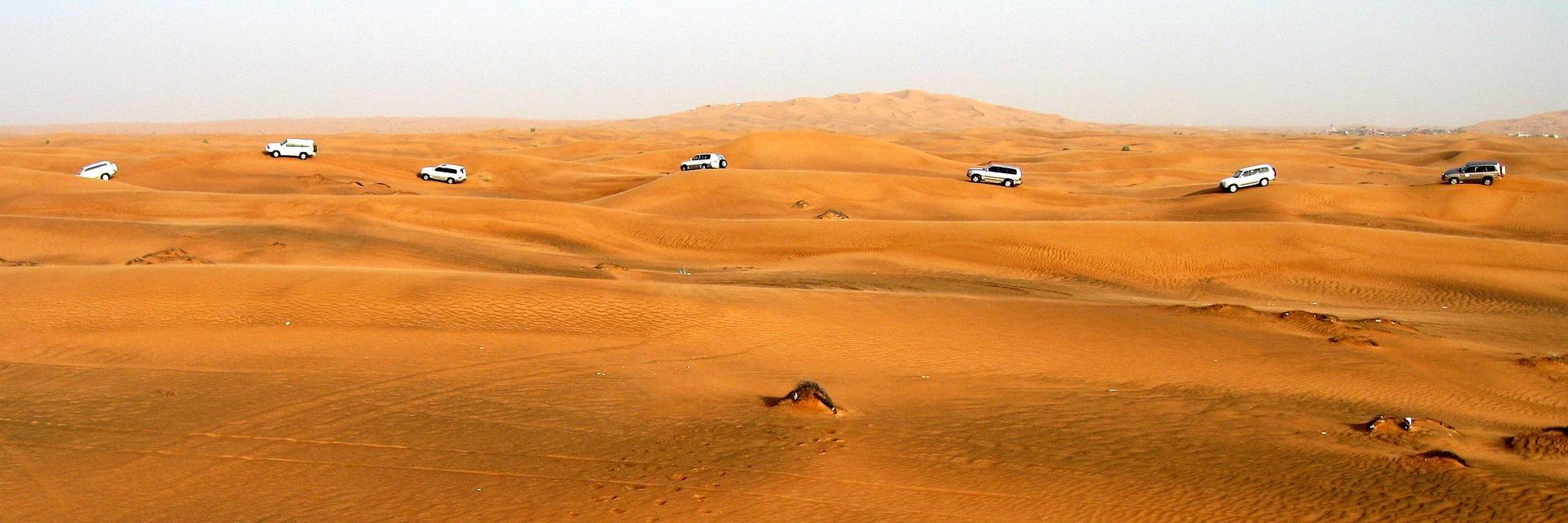
- Sand on the road reduces grip and can hide the edge of the road. Slow down and leave a bigger gap.
- Heavy rain is rare but causes flooding. Do not drive into water when you cannot see how deep it is.
- Sun glare at sunrise and sunset can blind you. Slow down and use sunglasses and the visor.
What should you do after a crash?
- Stop in the safest place. If your car can still be driven, move it off the live lanes: in Dubai you can be fined for not moving a drivable vehicle.
- Switch on your hazard lights and get out on the side away from traffic. Place a warning triangle if you have one.
- Check for injuries. Do not move injured people unless they are in danger.
- Call 999 for the police. For an ambulance call 998, and for fire 997, as listed on the UAE government emergency page.
- For a minor collision in Dubai, the RTA handbook says to report it through the Dubai Police app.
What to do next
If you are getting a licence, these rules are the core of the RTA Knowledge Test. Read our guide to passing the RTA theory test, learn the UAE road signs, then sit the free ExamReady UAE theory practice test. Visitors driving on a home licence should read our guide to driving in Dubai with a foreign licence first.
Rules and fines are correct as of November 2026. Speed limits in particular change, so always follow the signs on the road.
Related Guides
Continue learning with these related articles
UAE Traffic Fines and Black Points 2026: Full Table and Rules
UAE traffic fines and black points from the federal table: speeding, red lights, phones, seatbelts, what 24 points means and penalties under the 2024 law.

Eye Test for Driving Licence Abu Dhabi, Al Ain and Dubai (2026)
Eye test for a UAE driving licence: where to go in Dubai, Abu Dhabi and Al Ain, the AED 140-180 RTA fee, what is tested, glasses, validity and failing.
RTA Parking Test 2026: Smart Yard Test Booking, Fees and Tips
How the RTA parking (Yard) test works in Dubai's smart yards: the five manoeuvres, booking online or in the RTA app, the AED 220 fee and why learners fail.
Motorcycle Licence Dubai 2026: Bike Licence Cost, Age and Tests
How to get a motorcycle licence in Dubai in 2026: age 17, 8 hours of lectures, RTA tests and fees, bike licence prices, foreign licence exchange and helmets.
Ready to test your knowledge?
Put what you've learned into practice with our free driving theory practice tests.
Start Practicing