Cayman Islands Road Signs: A Complete Visual Guide for Drivers
Master all Cayman Islands road signs for your DVDL theory test. Warning, regulatory, information, and priority signs explained by shape, colour, and meaning with test-day strategies.
Key Takeaways
- Cayman Islands road signs follow international conventions: triangles warn, circles give orders, rectangles inform, and the octagon means stop.
- Roundabout navigation errors are the number one cause of accidents in the Cayman Islands — knowing roundabout signs and lane rules is critical (Cayman Compass, 2026).
- Road sign questions make up a significant portion of the DVDL theory test (40 questions, 80% pass mark).
- Signs are colour-coded: red means prohibition or danger, blue means mandatory action, green means direction information.
How Are Road Signs Organised in the Cayman Islands?
The Cayman Islands uses a sign system based on the British and international Vienna Convention standards. Every sign communicates through three visual cues: shape, colour, and symbol. Once you understand the system, you can interpret unfamiliar signs even if you've never seen them before.
There are four main categories:
- Warning signs — Alert you to hazards ahead
- Regulatory signs — Tell you what you must or must not do
- Information signs — Provide guidance without giving orders
- Priority signs — Determine who has right of way
What Do Warning Signs Look Like?
Warning signs are triangular with a red border and white background. They tell you about hazards ahead so you can adjust your speed and attention. You'll see these throughout Grand Cayman, especially on coastal roads and near construction zones.
Common warning signs include:
- Curve Ahead — A sharp bend is coming; reduce speed before entering
- Road Narrows — The carriageway becomes narrower; prepare to give way to oncoming traffic
- Junction Ahead — An intersection is approaching; be ready to yield if necessary
- Pedestrian Crossing — Watch for people crossing; you must stop if someone is on the crossing
- School Zone — Reduce to 15 mph when amber lights are flashing. This limit applies even outside school hours if the lights are active
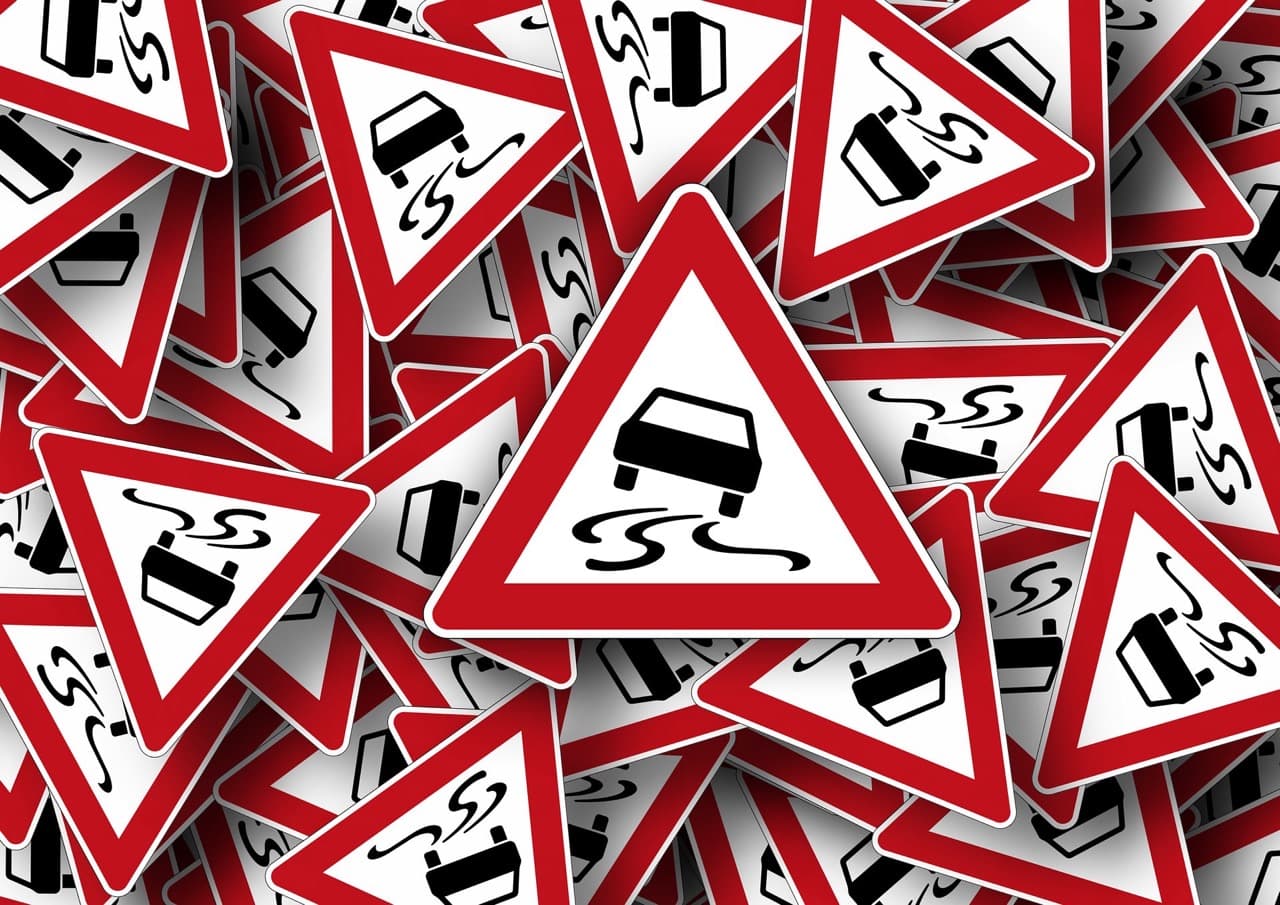
- Slippery Road — Road surface may be slippery, especially during Cayman's rainy season (May to November)
- Roundabout Ahead — A roundabout is coming; be ready to give way to traffic from the right
Why do warning signs matter on the test? Because they test whether you understand what to do when you see them — not just recognise them. "Curve ahead" doesn't just mean "there's a curve." It means "slow down before you enter the curve, not during it."
What Are Regulatory Signs?
Regulatory signs are circular and tell you what you must do or must not do. They carry legal force — ignoring them can result in fines or penalty points. They split into two sub-categories:
Prohibitory Signs (Red Circle Border)
A red circle means "don't." The symbol inside tells you what's prohibited:
- No Entry — White bar on red circle; you cannot enter this road from this direction
- No Overtaking — Two cars side by side; passing other vehicles is banned on this stretch
- Speed Limit — Number inside the red circle is the maximum speed in mph. Common limits: 25, 30, 40, 50 mph
- No Parking — Diagonal red line through blue circle; stopping or parking is banned
- No U-Turn — U-turn symbol with red strike-through; turning around is not permitted here
- No Horn — Horn symbol struck through; common near hospitals and residential areas
Mandatory Signs (Blue Circle)
A blue circle means "you must." These are less common but important:
- Keep Left / Keep Right — White arrow pointing the direction you must pass
- Roundabout Direction — Clockwise arrow showing traffic flow direction
- Minimum Speed — Number on blue background; you must maintain at least this speed
The most confusing pair for test-takers? No Entry vs. No Overtaking. Both are red circles, but No Entry has a horizontal white bar, while No Overtaking shows two cars. Learn to spot the difference instantly.
What Do Information Signs Tell You?
Information signs are rectangular and come in blue, green, or brown backgrounds. They don't give orders — they help you navigate and find services.
- Direction signs (green) — Point to destinations with distances. On Grand Cayman, you'll see these on the main highway pointing to George Town, West Bay, Bodden Town, and other districts
- Facility signs (blue) — Hospital (white H), parking (white P), petrol station, airport
- Tourist signs (brown) — Point to beaches, dive sites, nature reserves, and attractions
- One-way street — White arrow on blue rectangle; traffic flows in one direction only
These appear less frequently on the theory test than warning or regulatory signs, but they're still worth knowing. Don't skip them entirely.
How Do Priority Signs Work?
Priority signs determine who goes first at intersections, junctions, and narrow passages. They're some of the most important signs to understand because getting priority wrong causes collisions.
- Give Way (Yield) — Inverted triangle with red border. You must slow down and yield to traffic that has priority. Come to a complete stop if necessary.
- Stop — Red octagon with white text. You must come to a complete stop, even if the road appears clear. This is the only octagonal sign — you can recognise it by shape alone even from behind.
- Priority Road — Yellow diamond with white border. You are on the road with right of way; traffic from side roads must yield to you.
- End of Priority — Same diamond shape with a diagonal black line through it. You no longer have automatic priority.
At roundabouts in the Cayman Islands, you give way to traffic approaching from your right (traffic already on the roundabout). This is the single most important priority rule in Cayman — and the most commonly violated one.
What Road Markings Should You Know?
Road markings painted on the surface complement road signs. They're just as important and frequently tested:
- Solid white centre line — Do not cross or overtake. Treat it as a wall.
- Broken white centre line — You may cross when it's safe to overtake
- Double yellow edge lines — No parking or waiting at any time
- Single yellow edge line — Parking restrictions apply at certain times (check nearby signs)
- Zebra crossing markings — Black and white stripes where pedestrians have absolute priority
- Hatched areas — Diagonal lines within a border; do not enter unless safe and necessary
A common test question: "Can you overtake on a solid white line?" The answer is always no, except to pass a stationary obstruction when safe to do so.
How to Study Road Signs for the Theory Test
Here's the most efficient approach we've seen work for Cayman test-takers:
- Learn by category first — Master all warning signs, then regulatory, then information, then priority. Don't mix categories until you're solid on each.
- Use the shape-colour shortcut — If you know "triangle = warning" and "red circle = prohibition," you can narrow down answers before reading options
- Focus on the confusable pairs — No Entry vs. No Overtaking, Give Way vs. Stop, speed limit vs. minimum speed
- Test yourself actively — Use the ExamReady Cayman Road Signs page to quiz yourself. Passive reading doesn't build recall.
- Practice while riding — As a passenger, try to identify every sign you pass. This builds real-world recognition speed.
Signs You'll See Most Often on Grand Cayman
Knowing which signs appear most frequently helps you prioritise your study time. On Grand Cayman's road network, these are the signs you'll encounter daily:
- Speed limit signs (30/40 mph) — Posted throughout George Town, Seven Mile Beach, and the highway corridor
- Roundabout ahead warnings — Grand Cayman has numerous roundabouts; you'll see these at every approach
- Give Way signs — At roundabout entries and T-junctions across the island
- School zone signs — Near every school with the 15 mph flashing amber lights
- No parking signs — Common in George Town and along West Bay Road
- One-way street signs — Several streets in George Town's commercial district are one-way
Being able to instantly recognise these high-frequency signs means you'll answer those test questions without hesitation, leaving more time for the trickier ones.
Related Guides
Explore more resources to prepare for your Cayman Islands driving test:
- Complete Guide to the Cayman Islands Driving Test 2026 — the full overview
- How to Pass the Theory Test — study strategy and tips
- Speed Limits & Road Rules — rules every driver must know
- Pass Rate & Statistics — why 52.5% of candidates fail
Frequently Asked Questions
How many road sign questions are on the DVDL theory test?
Road signs typically make up 30-40% of the 40-question DVDL theory test. You can expect 12-16 questions about sign recognition, road markings, and their meanings. The test requires 32 correct answers (80%) to pass (DVDL).
Does the Cayman Islands use British or American road signs?
Cayman uses a British-influenced system with some international elements. Signs follow the same shape-colour conventions as the UK (triangles warn, circles order), and speed limits are posted in mph, not km/h. The Cayman Islands drives on the left, consistent with British tradition.
What's the most commonly failed road sign question?
Roundabout priority and give-way rules are the most frequently missed. Many test-takers don't understand that you must yield to traffic approaching from your right at roundabouts. This is also the leading cause of real-world accidents in Cayman (Cayman Compass).
Are road markings tested on the theory test?
Yes. Questions about solid vs. broken white lines, double yellow lines, and zebra crossing rules appear regularly. Know the difference between "you may cross" (broken line) and "you must not cross" (solid line).
Where can I practice road sign recognition online?
Use the ExamReady Cayman Islands Road Signs section to browse all signs with descriptions, or take a practice test that includes sign-based questions mixed with other topics.
Related Guides
Continue learning with these related articles

Cayman Islands Road Code Book 2026: Free PDF Download, Printed Copy Price and What It Covers
Where to download the Cayman Islands Road Code as a free PDF, where to buy the CI$10 printed booklet, what it covers and which rules in it are out of date.

Cayman DVDL Fees Cut 2026: Non-Caymanian Rates Reduced
Cayman DVDL fees from 1 Sept 2026: a 3-year non-Caymanian licence is CI$225, not CI$600. Caymanians get multi-year discounts. Test fees unchanged.
DVDL Cayman Islands Offices: Locations, Opening Hours, Online Services, Appointments and Fees (2026)
Where the DVDL Cayman Islands offices are, their opening hours, My DVDL e-Services, how to book a test, and the driver's licence fees from 1 September 2026.
Cayman DVDL Fee Increase: New Two-Tier Fees From 1 September 2026
Cayman's two-tier DVDL fees started 1 Sept 2026, with the non-Caymanian licence rates cut to 3x the night before (CI$225 for 3 years, not CI$600). Test fees are 4x: written CI$100, road test CI$200.
Ready to test your knowledge?
Put what you've learned into practice with our free driving theory practice tests.
Start Practicing